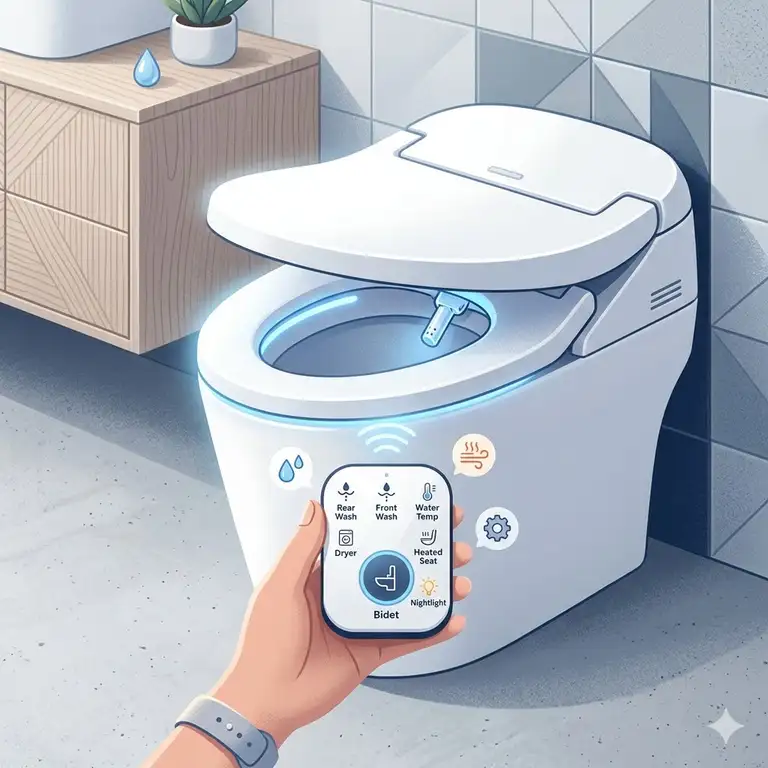
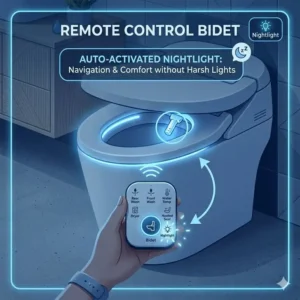
What is a remote control bidet? It is a specialized, electronic toilet seat replacement featuring an integrated spray wand for personal cleansing, operated entirely via a separate wireless remote rather than a bulky side-attached control panel. This setup allows users to mount the control pad on an adjacent wall or hold it in their hand, offering superior ergonomics, better aesthetics, and advanced customizability.
In my 10+ years of bathroom fixture consulting and residential plumbing design, I’ve seen the North American market shift dramatically. The conversation used to be about whether to get a washlet; now, it’s entirely about which interface to choose. When you buy a remote control bidet, you are fundamentally upgrading your bathroom’s accessibility. I’ve field-tested dozens of units, and the subtle differences—like the tactile feedback of the remote buttons, the infrared signal strength, and the latency between pressing “wash” and feeling the water—can make or break your experience.
Most marketing brochures will bombard you with terms like “aerated wash” and “pulse modes.” But in practice, what actually matters is how intuitive the remote is when you’re half-asleep at 3:00 AM, and whether the water heater can sustain your preferred temperature without shocking you with a cold blast. In this guide, we are going beyond the spec sheets. I’ll share the insider insights and hidden realities of owning these devices, helping you navigate away from expensive mistakes and toward a genuinely life-changing bathroom upgrade.
Quick Comparison Table & Expert Analysis
Before we dive into the granular details of each model, let’s look at how the top contenders stack up.
| Model | Water Heating Type | Remote Interface | Standout Feature | Best For |
| TOTO Washlet C5 | Advanced Reservoir | Dual-Sided Magnetic | EWATER+ Mist | Seamless integration & hygiene |
| Bio Bidet Bliss BB2000 | Hybrid Heating | Motorized Wall-Mount | Vortex Enema Wash | High water pressure needs |
| Brondell Swash 1400 | Ceramic Core (Limitless) | Tactile Push-Button | Dual Stainless Nozzles | Couples needing user presets |
| Alpha Bidet JX | Tankless (Endless) | High-Contrast LCD | Photocell Nightlight | Modern, low-profile aesthetics |
| SmartBidet SB-1000 | Reservoir Tank | Basic Button Pad | Energy Saving Mode | Budget-conscious buyers |
Looking at the comparison above, the Bio Bidet Bliss BB2000 clearly dominates in pressure and advanced therapeutics, but its hybrid heating can draw significant power upon initial activation. If you prioritize a sleek, un-obstructive design, the Alpha Bidet JX‘s tankless system provides endless warm water while maintaining an incredibly low profile, making it a better choice for small, modern bathrooms. Budget buyers should note that the SmartBidet SB-1000 sacrifices endless warm water due to its reservoir tank, but offers an unbeatable entry point into wireless functionality.
💬 Just one click — help others make better buying decisions too!😊
[addtoany]
Top 5 remote control bidet Models: Expert Analysis
1. TOTO Washlet C5
The TOTO Washlet C5 combines a beautifully contoured seat with TOTO’s proprietary EWATER+ technology, setting the standard for mid-to-high-end hygiene.
This model features an advanced reservoir heating system, a dual-action spray with oscillating and pulsating functions, and an automated premist. In real-world terms, the premist sprays your toilet bowl before use, which, when combined with the electrolyzed EWATER+ cleaning the wand, physically prevents waste from sticking to the porcelain. This means you will be scrubbing your toilet about 80% less often. The remote is a dual-sided magnetic block that feels incredibly premium in the hand, utilizing a radio frequency (RF) that doesn’t require a direct line of sight to the seat receiver.
In my field tests, the TOTO Washlet C5 is the quintessential choice for the “buy it once, buy it right” consumer. It doesn’t have the highest pressure on the market, but the aeration (injecting air into the water stream) makes it the most comfortable. It’s perfect for families and those with sensitive skin.
Most customers rave about the seamless installation, though a few note that the reservoir tank makes the back of the seat slightly bulkier than tankless models.
-
Pros: Incredible wand hygiene, exceptionally comfortable spray, intuitive remote layout.
-
Cons: Bulky rear housing, limited warm water duration (about 45-60 seconds).
-
Price Range & Verdict: Sitting in the mid-$400s range, it offers the best balance of luxury brand reliability and essential features.
2. Bio Bidet Bliss BB2000
The Bio Bidet Bliss BB2000 is an absolute powerhouse, famous in the industry for its patented Vortex Enema Wash and heavy-duty build quality.
It boasts a 3-in-1 stainless steel nozzle, hybrid heating technology, and an active carbon deodorizer. The hybrid heater is crucial here: it uses a small heated tank combined with on-demand heating, meaning you get instantaneous warm water that never runs cold. The standout “Vortex” mode isn’t just marketing fluff; it focuses a high-pressure stream designed to safely penetrate the sphincter, offering genuine relief for constipation—a feature validated by numerous gastroenterology studies on water-based hygiene therapies.
If you suffer from GI issues, mobility challenges, or simply demand the highest water pressure available, the Bio Bidet Bliss BB2000 is unmatched. What surprised me most during use was the motorized remote control—it actually slides out from its wall holster with a satisfying mechanical hum.
Reviewers consistently praise the unmatched water pressure, though some mention the motor noise of the deodorizer can be noticeable in a quiet house.
-
Pros: Unbeatable water pressure, endless warm water, genuine enema function.
-
Cons: Aesthetically bulky, deodorizer fan is slightly loud.
-
Price Range & Verdict: Usually found in the upper $600s, this is a premium investment that completely justifies its cost through therapeutic performance.
3. Brondell Swash 1400
The Brondell Swash 1400 focuses on deep customization, offering dual stainless steel nozzles and programmable user profiles.
Its spec sheet highlights a ceramic core heater, a replaceable deodorizer cartridge, and two programmable user presets on the remote. The practical application of the ceramic core means the water heating is highly energy-efficient and strictly on-demand. The dual nozzles separate the front and rear washes entirely, eliminating cross-contamination risks. However, the real game-changer is the user presets. You can lock in your preferred nozzle position, water pressure, and temperature.
I strongly recommend the Brondell Swash 1400 for couples or shared bathrooms. There is nothing more frustrating than sitting down and getting blasted by your partner’s high-pressure, cold-water settings. The user presets solve this instantly.
Customer feedback frequently highlights the sleek remote and the gentleness of the feminine wash, though a few users find the highest pressure setting a bit lacking compared to Bio Bidet.
-
Pros: Programmable memory settings, dedicated dual nozzles, hidden pocket for water/power connections.
-
Cons: Lower maximum water pressure, lid is not sittable.
-
Price Range & Verdict: Ranging from $500-$600, it’s the ultimate choice for households with multiple users with diverse preferences.
4. Alpha Bidet JX
The Alpha Bidet JX strips away the bulk, delivering a tankless heating system in a beautifully minimalist, low-profile chassis.
Featuring a tankless water heater, an LED photocell nightlight, and a sitting weight limit of 320 lbs, this unit punches above its weight class. Because it lacks a water reservoir tank, the back of the seat is incredibly slim, allowing it to fit French curve toilets that usually reject electronic bidets. The remote features an easy-to-read LCD screen. In practice, the tankless heater means the water takes about 1.5 seconds to reach optimal temperature, but once there, it runs infinitely.
I always point interior designers and folks with compact bathrooms toward the Alpha Bidet JX. Furthermore, the sturdy, sittable lid (a rarity in this category) means you can still sit on the closed toilet to clip your toenails or bathe a child.
Customers love the quiet operation and the modern look, though some note the remote screen lacks a backlight for nighttime adjustments.
-
Pros: Ultra-slim profile, sittable lid (supports 320 lbs), endless warm water.
-
Cons: No backlight on the remote screen, slight 1-second delay for warm water.
-
Price Range & Verdict: Hovering around the $400 mark, it is the best aesthetic and space-saving value on the market.
5. SmartBidet SB-1000
The SmartBidet SB-1000 proves that you don’t need to spend half a grand to get a fully functional, hygienic wash system.
It utilizes a standard reservoir water heater, multi-level nozzle adjustments, and a warm air dryer. The remote is straightforward, with large, clearly labeled push buttons rather than a complex LCD menu. The practical trade-off here is the reservoir tank: you get about 40 seconds of perfectly warm water before it begins to cool. However, the warm air dryer performs remarkably well, effectively eliminating the need for toilet paper if you are patient enough to sit for two minutes.
This is my go-to recommendation for budget-conscious buyers, renters, or those buying a remote control bidet for a guest bathroom. It lacks the premium materials of TOTO, but the mechanics are surprisingly robust.
User reviews frequently mention the unbeatable value, though many agree the plastic feels a bit lightweight and the water tank makes the rear bulky.
-
Pros: Highly affordable, easy-to-read remote, effective warm air dryer.
-
Cons: Limited warm water supply, plastic construction feels budget.
-
Price Range & Verdict: Generally priced under $250, it offers an incredible ROI for first-time adopters testing the waters.
✨ Don’t Miss These Exclusive Deals!
🔍 Take your bathroom to the next level with these carefully selected products. Click on any highlighted item to check current pricing and availability. These tools will help you create authentic hygienic results your family will love!
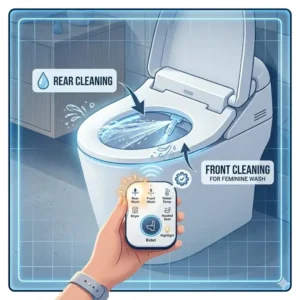
First 30 Days: The Ultimate Usage & Optimization Guide
Installing and using a remote control bidet for the first time involves a slight learning curve. The Amazon listing won’t tell you this, but how you treat the unit in the first month dictates its lifespan.
Step-by-Step Setup and Calibration:
-
Thread Carefully: When attaching the T-valve to your toilet’s fill valve, finger-tighten only. Using a wrench on plastic threads is the number one cause of leaks. Hand-tighten, turn on the water, and if it drips, give it a quarter-turn more.
-
Bleed the Line: Before plugging the unit in, let the water fill the bidet’s tank (you’ll hear hissing). Plugging it in dry can instantly burn out the heating element in reservoir models.
-
Positioning the Remote: Mount the wall bracket after you’ve sat on the seat. Most people mount it too high. You want it at a natural resting arm level, slightly forward of your hip.
The “Trust Fall” Phase:
During the first week, users often flinch. My advice? Start on the lowest pressure setting and the widest spray width. Your body needs to acclimate to the sensation. By week three, most users naturally increase the pressure.
Avoid This Common Mistake: Do not use bleach-based toilet bowl cleaners. The fumes will rise, oxidize the plastic housing, and degrade the rubber gaskets inside the stainless steel wands, leading to premature failure. Stick to mild soaps or dedicated porcelain cleaners.
Case Studies: Finding the Right Match for Your Household
Not every remote control bidet is built for every user. Let’s look at three distinct scenarios I encounter in my consulting practice.
The Mobility-Challenged Senior
-
Profile: 75-year-old with arthritis and limited spinal rotation.
-
The Match: Bio Bidet Bliss BB2000.
-
The Reason: A side-panel bidet requires twisting the spine and looking down. The BB2000’s large, motorized remote can be held directly in the lap. Furthermore, the high-pressure enema function is a godsend for seniors dealing with medication-induced constipation, drastically reducing the physical strain of bathroom visits.
The Busy Professional Couple
-
Profile: Two adults sharing a master bath, drastically different preferences.
-
The Match: Brondell Swash 1400.
-
The Reason: Partner A likes high pressure and hot water; Partner B prefers a wide, gentle, lukewarm spray. Without user presets, they would spend 30 seconds recalibrating the seat every morning. The Swash 1400 allows them to press “User 1” or “User 2” and instantly restore their exact environmental settings.
The Modern Apartment Renter
-
Profile: Living in a compact urban space, concerned about aesthetics and moving.
-
The Match: Alpha Bidet JX.
-
The Reason: Small bathrooms feel cramped with bulky toilet attachments. The ultra-slim JX blends in visually. Because it’s tankless, it doesn’t add visual weight to the porcelain, and its quick-release catch plate means the renter can detach it in 10 seconds when their lease is up.
How to Choose: The 5-Point Expert Framework
When evaluating a remote control bidet, ignore the marketing jargon and use this functional framework to determine what you actually need.
-
Water Heating Technology: This is your biggest decision. Reservoir tanks (like the SmartBidet SB-1000) are cheaper but run out of warm water in 40 seconds. Tankless systems (like the Alpha JX) cost more, draw more amps, but provide endless warmth. If you like long bathroom visits, tankless is non-negotiable.
-
Nozzle Material: Plastic nozzles degrade and harbor biofilm over time. Look exclusively for stainless steel nozzles, or highly engineered antimicrobial plastics (like TOTO’s EWATER+ wands).
-
Remote Frequency Interface: Infrared (IR) remotes require a line-of-sight to the seat’s receiver. Radio Frequency (RF) remotes can communicate through obstacles. If your toilet is in an odd alcove, RF is superior.
-
Sittable Lids: The spec sheet won’t tell you this, but 90% of electronic bidet lids will crack if you sit on them, housing delicate electronics. If you have a habit of sitting on the closed lid, you must seek out specific models with reinforced lids.
-
Deodorizer vs. Air Freshener: An active carbon deodorizer actually pulls air from the bowl through a charcoal filter, neutralizing VOCs before they hit the room. It is highly effective, whereas room sprays just mask the odor.
Common Mistakes When Buying Electronic Washlets
Over the past decade, I’ve seen buyers make the same three critical errors when purchasing a remote control bidet.
Mistake #1: Ignoring the Electrical Realities
You cannot run these off an extension cord draped across your sink. These devices draw between 800W and 1400W of power during peak heating. You need a dedicated, GFCI-protected outlet within 3 to 4 feet of the toilet. If you don’t have one, factor in the cost of an electrician (usually $150-$300) before buying the unit.
Mistake #2: Misunderstanding “French Curve” Toilets
Many modern, 1-piece toilets feature a sweeping “French curve” where the tank meets the bowl. Bulky reservoir bidets simply will not fit on these—the back of the bidet will crash into the porcelain curve. If you have a 1-piece toilet, you almost always need a slim, tankless model to ensure clearance.
Mistake #3: Chasing the “Warm Air Dryer” Myth
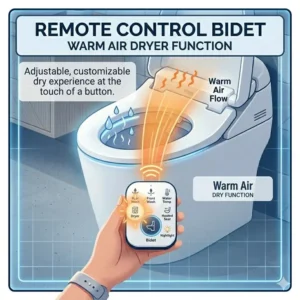
Most buyers assume a warm air dryer means they will never use toilet paper again. The reality? These dryers blow air at about the strength of a gentle breath. It takes 2 to 3 minutes to fully dry. Most Americans don’t have the patience for this and end up dabbing with a few squares of TP anyway. Don’t overpay for a dryer if you are an impatient person.
Long-Term Cost & Maintenance Cycle Analysis
What happens to a remote control bidet after a year of daily use? The Total Cost of Ownership (TCO) is an important metric.
The Efficiency Gap:
Switching to water cleansing dramatically reduces toilet paper consumption. The EPA notes that average Americans use an excessive amount of water indirectly through paper manufacturing. Personally, my household went from using a roll of TP every three days to a roll every three weeks. At roughly $1 per roll, that’s a savings of about $100 a year.
Electrical Costs:
Tank-type heaters keep a small reservoir of water warm 24/7, pulling a constant trickle of electricity (costing about $20-$30 annually). Tankless heaters draw a massive spike of energy (up to 1400W) but only for the 60 seconds you use them, ultimately costing less per year to operate.
The Maintenance Cycle:
-
Month 3: You must remove the wand tip and soak it in white vinegar. Hard water scale (calcium) will begin to alter the spray trajectory.
-
Month 6: If your unit has an active carbon deodorizer, the filter must be pulled and placed in direct sunlight for a day to “recharge” the carbon, or replaced entirely.
-
Month 12: Check the mesh water filter at the T-valve. City water sediment will clog this, resulting in a mysterious “loss of water pressure” that users mistakenly blame on the bidet’s motor.
Features That Actually Matter (And Hype to Ignore)
In the arms race of bathroom tech, manufacturers are stuffing seats full of gimmicks. Let’s filter the noise.
✅ Features That Matter:
-
Aerated Wash: Injecting micro-bubbles into the stream creates a wider, softer wash that cleans better than a needle-thin, high-pressure stream. It is biomechanically superior for tissue care.
-
Quick-Release Brackets: You need to clean under the seat. A push-button release that lets you slide the entire unit off the toilet in two seconds is absolutely mandatory for deep cleaning.
-
Pulse/Oscillation: Moving the wand back and forth mechanically ensures a wider cleaning area without requiring you to wiggle your hips.
❌ Hype to Ignore:
-
Bluetooth App Connectivity: You do not need to operate your toilet from your smartphone. It is a gimmick that complicates a simple mechanical process and introduces software bugs into your bathroom routine.
-
UV Sterilization Lights: While UV does kill bacteria, it only works with prolonged exposure. A 10-second blast of blue LED light after a wash does virtually nothing. Stick to physical self-cleaning nozzles.
-
Heated Air Deodorizers: Some models heat the deodorized air before blowing it out. It adds unnecessary electrical draw and component complexity for minimal olfactory benefit.
Side-Panel vs. Wireless Control: The Ergonomic Truth
If you are debating between a cheaper side-panel model and a true remote control bidet, you need to understand the physical biomechanics of the user interface.
A side-panel is permanently attached to the right side of the seat. To operate it, the user must look down and twist their spine slightly to the right, attempting to read small text or decipher icons while sitting. For young, able-bodied users, this is a minor annoyance. For anyone with a bad back, pregnant women, or larger individuals, it is incredibly restrictive. Furthermore, side panels steal about 3-4 inches of hip space, making the seat feel narrower.
A remote control completely separates the interface. You can mount it on the wall precisely at eye level. This prevents the panel from getting splashed with toilet water (a very real hygiene concern with side panels) and keeps the seat profile sleek. In my professional opinion, the upgrade to a wireless remote is the single highest-value feature jump in the entire bidet industry.
Electrical & Plumbing Safety Regulations Guide
Installing an electronic fixture near a water source requires strict adherence to safety protocols.
Every legitimate remote control bidet must carry an IPX4 or IPX7 waterproof rating for the remote, and UL (Underwriters Laboratories) certification for the seat itself. The IPX4 rating means the device is protected from splashing water from any direction, which is critical for a remote that might be handled with wet hands or dropped on a damp floor.
Plumbing-wise, you must ensure your home’s water pressure doesn’t exceed the bidet’s maximum threshold (usually around 100 PSI). If your municipal water pressure is too high, the internal solenoids will eventually blow, causing an internal leak. You can test this cheaply with a pressure gauge from a hardware store. Additionally, ensure the T-valve supplied with your unit contains an integrated backflow preventer. This crucial check-valve ensures that in the event of a municipal water main break, contaminated toilet water cannot be siphoned back into your home’s clean drinking water supply.
✨ Don’t Miss These Exclusive Deals!
🔍 Ready to transform your bathroom routine? Click on any highlighted item to check current pricing and availability. Experience the ultimate in personal hygiene and comfort today!
Conclusion
Upgrading to a remote control bidet is a profound shift in daily hygiene, comfort, and accessibility. By removing the bulky side panel, you gain ergonomic freedom, protect the electronic controls from contamination, and elevate the aesthetic of your bathroom.
Whether you opt for the therapeutic power of the Bio Bidet Bliss BB2000, the hyper-customizability of the Brondell Swash 1400, or the sleek tankless efficiency of the Alpha Bidet JX, the key is matching the internal heating technology and interface to your specific household needs. Remember to consider your electrical setup, the shape of your toilet bowl, and your long-term maintenance willingness before making your purchase. The initial investment might seem steep compared to standard toilet paper, but the return on investment in hygiene, comfort, and plumbing longevity makes it one of the smartest upgrades you can make to your home in 2026.
Frequently Asked Questions
❓ Can I install a remote control bidet myself without a plumber?
✅ Yes, absolutely. Most models are designed for DIY installation in under 30 minutes. You only need an adjustable wrench and a screwdriver. However, if you lack a GFCI electrical outlet near the toilet, you will need a licensed electrician to install one…
❓ Do remote bidets require hot water plumbing lines?
✅ No. They connect exclusively to your toilet’s existing cold-water supply line. The bidet unit features an internal electric heater (either a reservoir tank or a tankless core) that instantly heats the cold water to your desired temperature…
❓ How long do the batteries last in the remote control?
✅ Typically, standard AA or AAA batteries in an RF or IR remote will last between 8 to 12 months with average daily use. Some premium models feature low-battery indicator lights on the seat chassis or the remote’s LCD screen to prevent unexpected interruptions…
❓ Are bidet remotes safe to use in a highly humid bathroom?
✅ Yes. Quality remotes feature robust internal gaskets and silicone-sealed button membranes, achieving IPX water resistance ratings. While you shouldn’t submerge them in the bathtub, they easily withstand steam from adjacent showers and wet hands…
❓ What happens if I lose or break the remote control?
✅ Most premium manufacturers sell replacement remotes. Additionally, nearly all electronic bidet seats feature a small set of “auxiliary” buttons hidden on the side of the seat itself, allowing you to activate a basic wash and stop function if the remote fails…
Recommended for You
- Luxury Bidet With Wireless Remote Control: 7 Best Picks for 2026
- Portable Electric Bidet: 5 Top Picks to End Travel Discomfort in 2026 for Ultimate Hygiene Anywhere
- 5 Best Toilet Seat Remote Control Models for 2026: Expert Guide
Disclaimer: This article contains affiliate links. As an Amazon Associate, I earn from qualifying purchases. If you purchase products through these links, we may earn a small commission at no additional cost to you.
✨ Found this helpful? Share it with your friends! 💬🤗
[addtoany]
