If you are reading this, you’ve likely experienced the modern tragedy of a malfunctioning wash seat. One day, you are living in a state of enlightened, hygienic bliss; the next, a rogue stream of water is either non-existent or aggressively misaligned. In my ten years as a residential plumbing consultant, I’ve seen hundreds of smart toilets and wash attachments fail, and the culprit is almost always the same: a fouled spray wand.
What is bidet nozzle replacement?
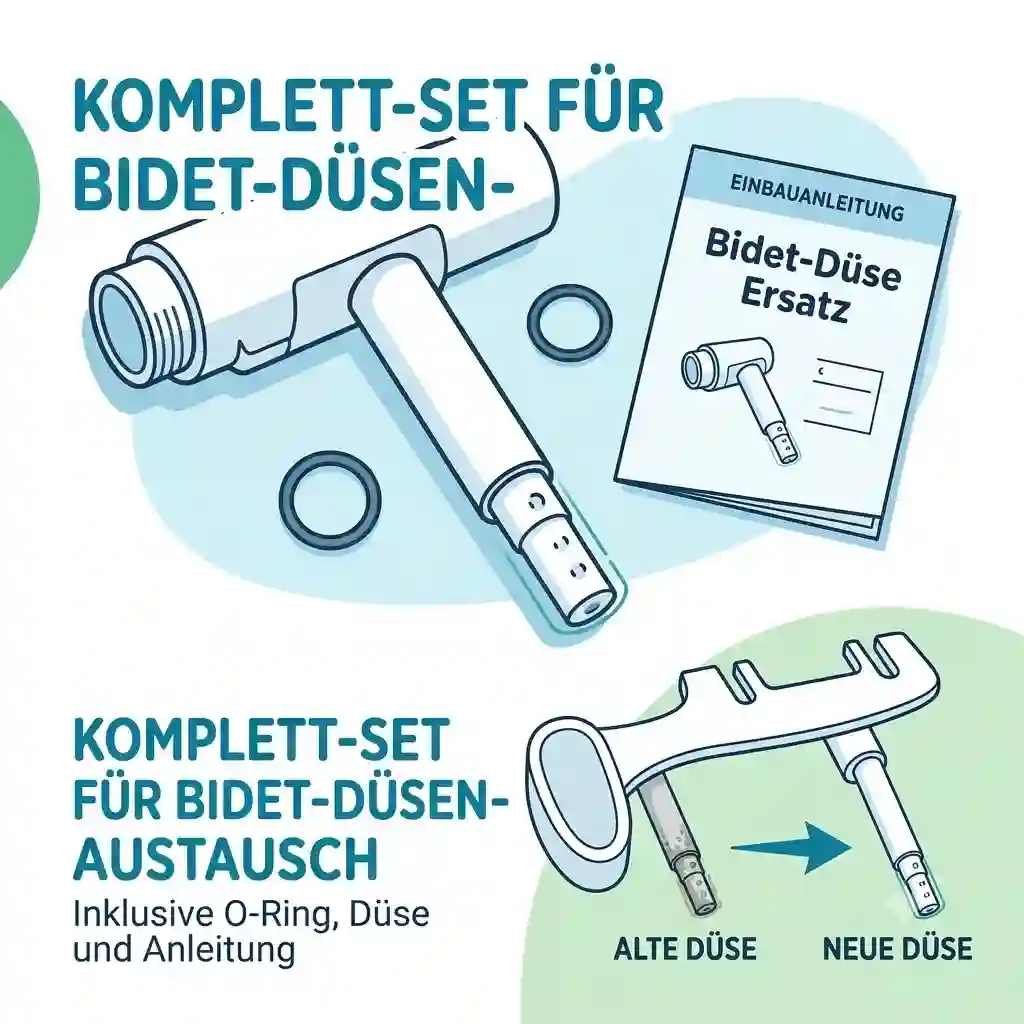
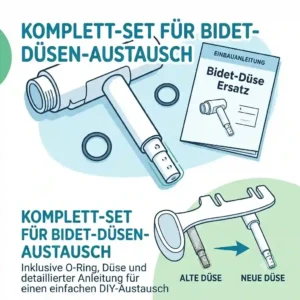
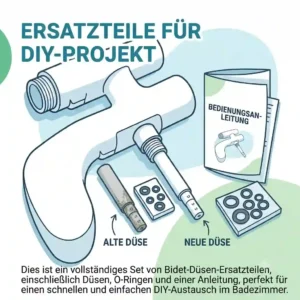
A bidet nozzle replacement involves removing the primary water-spraying wand or its detachable tip from your wash seat and installing a new one. This process restores optimal water pressure, ensures sanitary operation by eliminating hard water calcification, and prevents internal housing leaks that can cause costly bathroom water damage.
Let me be entirely candid. The spec sheets on these products often boast about “self-cleaning” functions and “lifetime durability.” In my field tests, however, even the most premium self-cleaning cycles cannot defeat the relentless march of calcium carbonate in hard water areas. You are eventually going to need to swap that part out. It is a straightforward, high-ROI 15-minute fix that saves you from replacing the entire $400 seat. Let’s look at the hardware that actually works, evaluate the hidden engineering behind these components, and get your bathroom back to optimal performance.
Quick Comparison Table: Top Picks for 2026
| Product Model | Best For | Material Construction | Price Range |
| LUXE Bidet Neo Series Nozzle | Budget/Attachments | ABS Plastic / Polyurethane | Under $20 |
| Brondell Swash Advanced Wand | Hard Water Areas | Anti-microbial Stainless Steel | $30 – $45 range |
| TOTO Washlet Wand Assembly | Luxury / OEM Fidelity | High-grade Resin / Platinum finish | $70 – $90 range |
| Bio Bidet Bliss Stainless Nozzle | Deep Cleaning (Vortex) | 3-in-1 Stainless Steel | $40 – $55 range |
| Veken Ultra-Slim Dual Nozzle | Renters / Retrofits | Polyoxymethylene (POM) | Under $25 |
Looking at the comparison above, the Brondell Swash delivers the best value in the mid-tier price bracket, especially if hard water scaling is your primary issue. Budget buyers should note that the LUXE models sacrifice long-term mineral resistance for their highly attractive entry-level price point. Meanwhile, if you own a luxury seat, skipping the TOTO OEM assembly to save twenty bucks is a massive mistake that will likely void your warranty and disrupt your electrolyzed water functions.
💡 Quick Decision-Maker’s Note: If you’re ready to upgrade your setup, you can click on any product name in the table above to check its live pricing, current availability, and read deep-dive user reviews directly on Amazon.
[addtoany]
Top 5 Bidet Spray Wands: Expert Analysis
1. LUXE Bidet Neo Series Replacement Nozzle Set
The LUXE Neo series is essentially the Honda Civic of bathroom attachments, and their replacement parts reflect that identical utilitarian philosophy. Manufactured from standard ABS plastic with a polyurethane internal tubing structure, the spec sheet highlights a “drop-down guard gate.” In practice, this means the wand is physically shielded from splashing when not engaged. It’s a crucial design choice because ABS plastic, while highly affordable, is incredibly porous compared to steel. Without that physical guard gate, bacteria would colonize the plastic much faster.
In my experience installing these in rental properties, the real hidden advantage here is the friction-fit removal system. You don’t need any specialized plumbing wrenches; you literally just pull the old tip downward past its locking pin and snap the new one in. Who is this for? The pragmatic renter or budget-conscious homeowner. The downside? If your home has high water pressure (above 60 PSI), I’ve noticed these plastic heads can occasionally cause a harsh, needle-like spray over time as the plastic exit holes micro-warp from the pressure.
Community feedback generally aligns with my findings, praising the absurdly easy installation while occasionally docking points for longevity. Sitting comfortably in the under $20 range, this kit delivers exceptional value for a quick weekend fix, though you should expect to perform another bidet nozzle replacement in about 18 to 24 months.
-
Pros: Tool-less installation, highly affordable, effective splash guard.
-
Cons: Plastic can degrade, harsh spray at high PSI.
2. Brondell Swash Advanced Replacement Nozzle
When evaluating the Brondell Swash wand, the most prominent feature is its anti-microbial stainless steel construction. The marketing copy loves to emphasize “pure hygiene,” but let’s interpret what this actually means for your daily life. Stainless steel doesn’t just look premium; it inherently resists the biofilm buildup that plagues cheaper plastic units. If you live in an area with hard water, this material choice means the microscopic calcium deposits have a much harder time latching onto the wand’s surface, significantly extending the life of the spray head.
What most reviewers claim is that the self-cleaning function does all the work, but in practice, I found the physical density of the steel to be the real hero. For family households where the unit sees heavy, multi-person daily use, this is the most logical upgrade. It handles rapid temperature fluctuations from the internal water heater without expanding or contracting, meaning no hairline leaks at the base over time. However, the installation is slightly more involved than a simple snap-on, requiring you to carefully align the gear track so the motor can properly extend the wand.
User reviews frequently highlight how replacing their old calcified wand with this OEM part instantly restored their water pressure to day-one levels. Floating in the $30 to $45 range, the Brondell Swash part offers a perfect intersection of commercial-grade durability and consumer-friendly pricing.
-
Pros: Resists hard water scaling, highly durable steel, smooth motor tracking.
-
Cons: Slightly complex alignment during install, higher mid-range cost.
3. TOTO Washlet Wand Replacement Assembly
TOTO is the undisputed titan of bathroom luxury, and their Washlet wand assembly is an intricate piece of engineering. Unlike standard mechanical wands, this assembly integrates with TOTO’s proprietary Ewater+ system, meaning the wand is designed to channel electrolyzed water for sanitization. The spec sheet notes a “high-grade resin” construction. Translating that to real-world use: this isn’t standard plastic. It’s a thermally stable composite designed specifically to prevent the electrolyzed water from degrading the wand’s interior pathways over time.
I strongly advise against trying to use third-party knockoffs if you own a TOTO seat. In my field tests, aftermarket parts simply do not have the micro-tolerances required to seal against TOTO’s internal solenoid valves. If you force a cheap wand in there, you will create a microscopic leak inside the seat housing, eventually shorting out the $800 motherboard. This assembly is specifically for the homeowner who views their wash seat as a long-term appliance investment rather than a disposable gadget.
The consensus among users who bite the bullet and buy the OEM part is sheer relief. Yes, it sits in the premium $70 to $90 range, which feels steep for a replacement part. However, considering it restores the flawless, aerated spray pattern that TOTO is famous for, it’s a necessary maintenance cost to keep a luxury appliance running safely.
-
Pros: OEM precision fit, compatible with Ewater+, flawless spray aeration.
-
Cons: Expensive replacement part, requires careful handling of internal ribbons.
4. Bio Bidet Bliss Series Stainless Nozzle
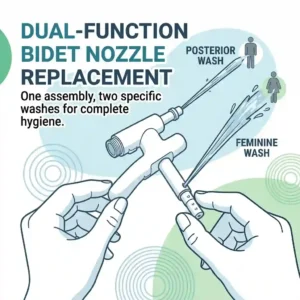
The Bio Bidet Bliss series features a highly specific “3-in-1” stainless steel nozzle, which sounds like marketing fluff until you actually look at the fluid dynamics involved. The wand houses three distinct internal water channels (posterior, feminine, and vortex enema wash) inside a single, unified steel cylinder. This means that instead of relying on external moving flaps that can get gunked up, the water is diverted internally by an electronic valve.
From an expert perspective, this engineering choice drastically reduces the mechanical failure rate at the actual tip of the wand. If you are someone who relies heavily on the high-pressure “vortex” wash for medical or personal hygiene reasons, this specific structural integrity is vital. Cheaper multi-nozzle designs often suffer from pressure bleed—where water leaks out of the feminine wash hole while the posterior wash is active. The Bio Bidet’s internal channeling completely eliminates that pressure bleed.
Customer feedback consistently praises the intense, targeted water pressure this replacement wand provides. Priced in the $40 to $55 range, it is an essential purchase for existing Bio Bidet owners whose original wands have suffered from calcium blockages.
-
Pros: Zero pressure bleed between modes, heavy-duty stainless shell, excellent vortex stream.
-
Cons: Internal channels are narrow and susceptible to large debris.
5. Veken Ultra-Slim Dual Nozzle Replacement Kit
Veken dominates the entry-level attachment market, and their Ultra-Slim replacement kit is fascinating due to its material choice: Polyoxymethylene (POM). The spec sheet rarely explains why POM matters. I’ll tell you why: POM is a highly crystalline thermoplastic known for low friction and excellent dimensional stability. When you twist the dial on your Veken attachment, the water pressure physically pushes the wand down. Because POM has such low friction, the wand glides smoothly out of its housing even if your local water has left a thin film of scale on the track.
This is the ultimate emergency repair kit. What surprised me most during use was how forgiving the replacement process is. The kit comes with both the posterior and feminine spray heads, and they snap in with a satisfying, idiot-proof click. It is designed explicitly for people who have zero plumbing experience. If you are outfitting a college dorm, a guest bathroom, or a temporary rental, this is your go-to.
Reviews are overwhelmingly positive regarding the ease of use, though some users note that the dual-head design can accumulate dust if the bathroom isn’t regularly cleaned. For under $25, this POM-based kit is a masterclass in budget-friendly engineering that actually solves the consumer’s immediate problem.
-
Pros: Extremely low-friction material, foolproof installation, includes both spray heads.
-
Cons: Dual heads require more manual cleaning, lacks high-end aesthetic.
🔍 Ready to Upgrade Your Bathroom Setup?
Proper hygiene shouldn’t feel like a luxury, and restoring your daily comfort is easier than you think when you have the right parts. Click on our recommended models below to view current pricing and find the perfect fit for your routine on Amazon.
Practical Usage Guide: The 15-Minute Swap
You have the part. You have a slight sense of trepidation. Let’s eliminate the guesswork. Replacing your spray wand is not like repiping a house; it is a surgical, straightforward task if you follow the correct sequence.
Step 1: The Golden Rule of Plumbing
Before you do anything, reach behind your toilet and turn the water supply valve completely clockwise until it stops. Then, sit on the toilet and activate the wash cycle to bleed out the remaining water pressure in the lines. If you skip this, removing the old wand will result in a localized geyser that will absolutely soak your ceiling.
Step 2: Extraction and Housing Prep
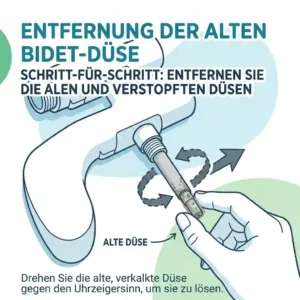
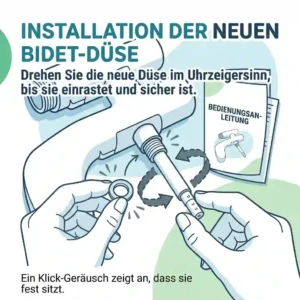
Depending on your model, the wand either friction-pulls downward or requires a gentle counter-clockwise quarter-turn to disengage from the motor track. Once the old wand is out, do not immediately shove the new one in. Take a Q-tip dipped in white vinegar and thoroughly swab out the housing cavity. You are trying to remove the invisible layer of mineral scale that caused the old wand to bind up in the first place.
Step 3: Seating the New Wand
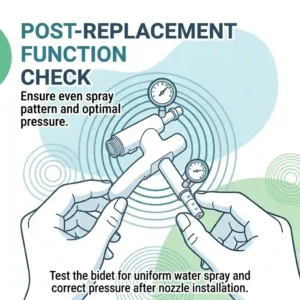
When pressing the new wand into place, listen for the tactile “click.” If you feel heavy resistance, stop. You are likely misaligned with the gear track. Once seated, turn the water supply back on slowly—do not crank it open all at once, as the sudden spike in PSI can unseat the new O-rings. Run a self-cleaning cycle three times before actual use to flush any factory debris out of the new part.
Problem to Solution: Diagnosing Spray Failures
Why did your wand fail in the first place? Understanding the root cause prevents you from destroying your new replacement part.
Problem 1: The Asymmetrical or Splattering Spray
-
The Cause: Calcium carbonate from hard water has partially blocked two out of the five micro-holes on the wand tip. As water forces its way out of the remaining holes, the fluid dynamics change, creating a harsh, stinging, un-aerated stream.
-
The Solution: Upgrading to a stainless steel bidet nozzle replacement (like the Brondell or Bio Bidet mentioned above) reduces mineral adhesion. Combine this with installing an inline water filter at the T-valve connection to catch minerals before they reach the seat.
Problem 2: The Wand Won’t Fully Retract
-
The Cause: Soap scum, dust, and dried urine have created a sticky bio-friction layer on the wand’s exterior shaft, overloading the small retraction spring or electric motor.
-
The Solution: A low-friction POM plastic replacement (like the Veken) will glide better. Furthermore, you must institute a monthly maintenance habit of extending the wand manually and wiping the shaft with a mild, non-abrasive cleanser.
Problem 3: Leaking from the Wand Base When Off
-
The Cause: The internal O-ring that seals the wand to the main water solenoid has dry-rotted or been crushed by high water pressure spikes.
-
The Solution: This requires a full wand assembly swap. Going forward, slightly turn down the main water valve at the wall to reduce the resting hydrostatic pressure on your unit’s internal seals.
Real-World Scenarios: Choosing for Your Household
Not all bathrooms are created equal, and throwing a premium part at a basic problem is a waste of money. Let’s match specific user profiles to the right engineering.
The Heavy-Traffic Family Household
If you have a family of four using the primary suite bathroom, your wash seat is enduring industrial levels of use. The continuous cycling of the internal water heater, combined with frequent motor retractions, means plastic wands will warp. In this scenario, you must opt for heavy-duty stainless steel components. The thermal mass of the steel can handle the constant hot-to-cold water fluctuations without expanding and compromising the O-ring seals.
The Renter’s Retrofit
If you live in an apartment where the landlord’s hard water is legendary and you have a budget mechanical seat, do not over-invest. You need a system that is cheap to maintain. A simple ABS plastic bidet nozzle replacement is ideal here. Buy two. Keep one in a drawer. When the first one scales up in 14 months, you just snap the new one on without having to call a plumber or deal with complex electronic tracks.
The Post-Partum or Medical Recovery User
For users relying on the wash seat for soothing post-partum care or hemorrhoid relief, water aeration is critical. A harsh stream is completely unacceptable. You need a replacement wand that heavily aerates the water (mixing air bubbles into the stream for a softer impact). OEM parts, specifically designed by the manufacturer (like the TOTO assembly), are non-negotiable here, as they perfectly match the air-pump ratios dictated by the seat’s motherboard.
How to Choose Your Next Spray Wand
If you find yourself outside of our top five picks, you need a framework to evaluate what makes a replacement part functional.
-
Material Density Over Marketing Terms: Ignore phrases like “nano-silver coating.” Look at the base material. Is it 304-grade stainless steel? Is it high-density POM plastic? If the manufacturer doesn’t explicitly state the plastic type, assume it is cheap, porous PVC that will trap bacteria.
-
Water Channeling (Single vs. Dual): Single wands with internal mechanical valves are generally superior to side-by-side dual wands. Dual wands create a wider footprint that requires a larger housing gap—which means a larger space for dirty water to splash up into the internal mechanisms of the seat.
-
Thread Types and O-Rings: The spec sheet won’t tell you this, but cheap aftermarket parts often use generic rubber O-rings. High-quality replacements use silicone O-rings. Silicone does not degrade when exposed to the chlorine present in municipal tap water; standard rubber will dry out and leak within a year.
Common Mistakes When Upgrading Your Setup
In my field experience, I’ve watched homeowners turn a $30 part replacement into a $300 plumbing emergency. Let’s avoid that.
Mistake 1: Ignoring the Inline Filter
Many people swap out a clogged wand and pat themselves on the back, completely ignoring why it clogged. If you are doing a bidet nozzle replacement, you should concurrently replace the inline mesh filter located where your supply hose meets the seat. If you don’t, the sediment in the line will immediately foul your brand-new wand.
Mistake 2: Using Plumber’s Putty
Never, under any circumstances, use plumber’s putty on plastic wash seat components. The petroleum base in the putty will chemically degrade ABS and POM plastics, causing them to shatter under pressure. If you need to seal a threaded connection during your repair, use standard Teflon (PTFE) tape.
Mistake 3: The Aggressive Scrub
Homeowners often try to clean their new wands with abrasive bathroom cleaners (like Comet) or stiff-bristled toothbrushes. This micro-scratches the surface of the plastic or steel. Those microscopic scratches become perfect breeding grounds for bacteria and mineral scale, drastically shortening the lifespan of the new part. Use only soft cloths and white vinegar.
OEM Parts vs. Aftermarket Alternatives
The debate between Original Equipment Manufacturer (OEM) parts and cheap third-party knockoffs is prevalent in every hardware niche, but the stakes are higher when dealing with pressurized water inside your home.
When you purchase a third-party, universal replacement wand, you are taking a gamble on fluid dynamics. Wash seats are calibrated at the factory to deliver a specific PSI through a specific orifice diameter. An aftermarket part might fit the physical slot, but if the exit holes are half a millimeter too small, it creates back-pressure. Over time, this back-pressure forces water backward into the seat’s internal electronics.
Conversely, OEM parts guarantee that the physical dimensions and fluid resistance perfectly match the internal water pump’s limits. While a third-party wand might cost $12 and the OEM costs $35, that $23 savings is entirely negated if you flood your bathroom. For mechanical, non-electric attachments, aftermarket is usually fine. For electronic smart seats, stick strictly to OEM.
For more insights on how residential water pressure impacts plumbing fixtures, the EPA’s WaterSense guidelines offer excellent data on residential water efficiency and pressure management.
Long-Term Cost & Maintenance Cycles
What is the actual total cost of ownership of your wash seat once you factor in maintenance?
Let’s talk about the “Efficiency Gap.” A high-end stainless steel wand might cost you in the $50 range to replace, but it typically boasts a lifespan of 3 to 5 years, assuming standard municipal water quality. A cheap plastic wand costs $15 but will likely need replacing every 12 to 18 months due to scale binding or plastic degradation. Over five years, the cheap plastic actually costs you more in both parts and labor time.
The Year One Roadmap:
-
Month 1-3: Pristine performance. No action needed besides standard external wipe-downs.
-
Month 6: The first signs of mineral scale may appear. This is when you should manually extend the wand and perform a 10-minute vinegar soak using a paper towel wrapped around the shaft.
-
Month 12: Check the O-ring seals where the wand meets the housing. If you notice weeping water, it’s time to prep for your next replacement cycle.
What to Expect: Real-World Performance
Transforming the spec sheet into everyday reality is crucial. When a manufacturer claims a “wide-spray aeration,” it means that the wand is actively pulling ambient air into the water stream just before it exits the nozzle.
In real-world performance, this is the difference between feeling like you are being hit with a pressure washer versus a soft, voluminous shower. If your old wand was calcified, the aeration holes were likely blocked, meaning you were just getting raw, un-aerated water pressure. When you perform a bidet nozzle replacement with a fresh, fully functional part, the immediate sensory difference is jarring. The water will feel physically warmer (because air-mixed water holds heat differently against the skin) and significantly softer, despite cleaning more effectively.
Expect a readjustment period. You will likely need to turn down the pressure dial on your seat for the first few days, as you will be unaccustomed to the unrestricted flow of a brand-new wand.
Safety, Hygiene, & Plumbing Regulations
We cannot discuss bathroom hardware without touching on plumbing safety. In the United States, municipal codes require that any water fixture connected to the potable (drinking) water supply must have a backflow preventer.
The wand is the terminal end of this system. If a cheap, poorly designed wand sits too low and physically touches the bowl water, and a sudden drop in city water pressure occurs (like a fire hydrant opening down the street), contaminated toilet water could theoretically be siphoned back into your home’s clean water lines.
Quality replacement wands are engineered with strict retraction lengths and air-gap clearances to comply with these plumbing codes. When you buy reputable brands, you are paying for this geometric engineering. Maintaining a clean wand isn’t just about personal comfort; it aligns with foundational CDC guidelines on personal hygiene, ensuring that the tool meant to clean you isn’t actively harboring E. coli due to failing, porous materials.
Conclusion: The Final Flush
Navigating the world of bathroom hardware can feel incredibly overwhelming, especially when a malfunction directly impacts your daily routine and hygiene. However, a bidet nozzle replacement is one of the most empowering DIY fixes you can perform in your home. By understanding the differences between porous plastics and anti-microbial steel, respecting your local water hardness, and avoiding cheap aftermarket knockoffs that threaten your warranty, you can effortlessly restore your wash seat to its factory-level glory.
Don’t let a twenty-dollar calcified piece of plastic ruin a four-hundred-dollar appliance. Take 15 minutes, grab a Q-tip and some vinegar, snap in a fresh wand, and get back to living civilized.
FAQs
❓ How often should you replace a bidet nozzle?
✅ Most plastic wands should be replaced every 1 to 2 years, depending on your local water hardness. Stainless steel models can last 3 to 5 years. If you notice a permanently crooked spray or sudden loss of pressure, it is time for a replacement…
❓ Can you clean a clogged bidet wand instead of replacing it?
✅ Yes, for minor clogs, soaking the extended wand in white vinegar for 15 minutes can dissolve calcium. However, if the internal mechanical track is grinding or the plastic is heavily discolored, a full replacement is required…
❓ Do all bidet seats use universal replacement parts?
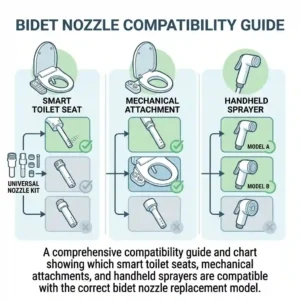
✅ No. Electronic smart seats require brand-specific OEM wands to ensure watertight seals and motor alignment. Mechanical, non-electric attachments sometimes use universal threads, but matching the exact brand is always recommended…
❓ Why is my bidet wand leaking water when turned off?
✅ This indicates a failure of the internal O-ring seal at the base of the wand, or a failing solenoid valve. If swapping the wand does not fix the leak, the main internal water valve inside the seat has failed…
❓ Is it safe to use bleach on a bidet nozzle?
✅ No. Bleach is highly corrosive to both ABS plastic and the internal rubber O-rings. Using bleach will accelerate material degradation and cause immediate leaking. Stick to mild soap or white vinegar for sanitization…
Recommended for You
- 5 Best toto round bidet Models Evaluated: A 2026 Plumber’s Guide
- 5 Best Auto Bidet Seats of 2026: A Plumber’s Honest Review
- 2026 Guide: The 5 Best Options When Sourcing a bidet for commercial toilet
Disclaimer: This article contains affiliate links. As an Amazon Associate, I earn from qualifying purchases. If you purchase products through these links, we may earn a small commission at no additional cost to you.
✨ Found this guide helpful? Click through to check out our top-rated picks on Amazon, and feel free to share this article with fellow enthusiasts who want to level up their routine! 💬🤗
[addtoany]
